Monday, June 20, 2011

Do it once and do it right!

Is the mantra that applies.
To the building. The real one!
The same does not necessary apply to the digital representation of the building.
In fact, trying to do a perfect model at first attempt (that will not change down the line) can seriously backfire on the model-authors.
Novice modellers and those that design projects around digital models for the first time all tend to want to do things only once. The thought of a model being dumped, replaced even lost terrifies them.
Maybe because of the effort that is needed to produce their first creation feels overwhelmingly large, they often insist in keeping half-baked formations and work on them well beyond used-by-dates.

You’ve got to learn to let it go. Start from scratch. Repurpose, rebuild.
Think of the screen as the digital sketch (butter) paper, you regularly screw up and throw away.
Or a word processor where entire paragraphs can be scratched and rebuilt.

In the olden days when software and hardware were much less reliable, there was the helping hand of a good old crash every now and again.

Redoing a model or any part of it has two benefits:
the model will be better next time, (you’ll find new issues with it, or the building it is supposed to represent that you’d missed so far)
and your modelling/model management skills will improve.


Sunday, June 19, 2011

BIM is about certainty...


...I utter this daily, often more than once to anyone caring to listen and those that don’t, but are still forced to.
So, one would think of me as well versed in certainty.

Interesting then, how much I freaked out when Graham (husband) was interviewed on AD Classic FM this week and broadcast predicting the moon to act in a certain way – 24hrs after the interview.
He talked beautifully, no ‘ohm’ or ‘ums’, only one ‘you know’. Did not get off the subject much, the interviewer kept him on the topic. Nothing to worry then...

I was paralysed with fear between the first airing of the clip and the moon finally eclipsing itself almost 30 hrs later.
Graham was ecstatic, driving around the town through the night to get the best shot of the phenomenon.
Afterwards, I was relieved. It happened, just as he (and admittedly many others) predicted.

Once I thawed enough, I could think of the experience a bit more rationally and look inwards for clues.
Have I been so damaged by the industry I work in, where things so regularly go wrong, that I no longer am able to look forward to little celestial celebrations without fear?

What did I think could happen?
Moon decide not to rise? Earth refuse to cast a shadow? Sun become all contractual?
Their budget blown over?


Saturday, June 18, 2011

Do they still sake male rulers in Germany?


I ask my German colleague and waive my (25+ years old) German made scale ruler at him.
Then we laugh, realising the silliness of what I’ve just said.

Needless to say the conversation quickly jumps from the scale ruler to computers and then the best make of cars, passing through globalisation, culminating in outsourcing.
Not surprisingly someone questions me owning one anyway (being all digital and BIMish), others extend the query to all of us, since we aren’t supposed to scale anything, anywere, anymore...

So, following a bit of quiet reflection I collect 4 contemporary uses of my German-made scale ruler:
As a bookmark in my very old fashioned diary
To underline/separate titles on printed drawing-list and construction programmes
To fold and rip A3 pages into halves
To indulge in a bit of nostalgia, remembering the times when Rotring, Steadler and Faber Castell ruled the industry;

..and while listing old tools of trade, let me mention:
My box of rapidograph-pens, I carried them around the world as I shifted houses and lives for two decades, disappeared in the last shift.
My stencils, a nice little collection of mainly orange (Rotring) and green (others) thin sheets of plastic, sold them a year ago.
The first-class-compass with the adjustable wheel, I paid an ‘arm and a leg’ for as a student was stolen while still studying. RIP.


Friday, June 17, 2011

Speaking of the BIM lingo...


Do you have trouble keeping up with the BIM jargon? You’re not alone, I can assure you.
Either because it is technology driven or due to it chronically suffering from the shortage of real news, BIM seems to get a boost of new terminology regularly.
For example: ‘software agnostic’.
Had to look up the meaning of the second word and even after quite some research into philosophy, software development and religion, am not quite sure how it applies to BIM?

I understand it refers to something being able to work with various systems rather than customised for a single one. So, if I am prepared to create my models using various platforms, the terminology applies to me?
Would a cross platform BIM count as a software agnostic BIM? Or would the creators of the cross-platform BIM be classified as the software agnostics?
(very helpful that the word can be both a noun and an adjective);

Does it imply across the board commitment (plays with everyone) or universal no commitment (questions everything)?

Not quite sure that I like this word, while it is easier to pronounce then ‘interoperability’, it sounds negative, agonising, angry.

And while we’re at reinventing the BIM language, let me highlight this again:
IFC (interoperable BIM file-format) is easily and often confused with IFC (documents issued for construction) when used on construction projects.


Thursday, June 16, 2011

Leave me alone: you are not my mum!


It was lucky I had my speakers off, on the laptop, otherwise the question Google Mail posed to me when I pressed the ‘send’ button would have really startled me.
“Did you mean to attach a file?” – a helpful note fleshed up instead. Your message says “attached please...but there is no file attached”...
This is quite creepy though – do they really scan every message I send or receive? For a chance to find places they can assist me? A sort of thin line between helpful and annoying...

Or is it just to control us all?

I know the horse has bolted on this one some time ago, Linkedin knows my address book inside out and FB bombards me with customised ads all the time.
I get suggestions to meet single available people locally.
Have they detected some activity on my husbands’ Gmail account that is prompting this avalanche?
Won’t be his FB or Linkedin, he demonstratively refuses to get manipulated by neither.

Are we being exploited?

For BIM’s future’s sake, I want universal connectivity between people and entities to happen sooner rather than later.
I wish for speedy information highways and clever vehicles to travel it.
I have zillions of ideas to plug into this, yet to become reality.

Still, an email system that acts like it was my mum? Aren’t ready for that, yet!


Wednesday, June 15, 2011

The lost dimension


Spare a thought for 3D today. It is losing ground even before it got really established.
Somehow, it’s no longer cool to do ‘just 3D’.
It is not BIM, they say. Does not count. It has to be 4, 5, 6D.
(oh, I despair when people keep hopping from one D to the next as if they were piano keys to tap);
You go BIM shopping, and it is no longer on the menu, at least not without the (just as despised by me) ‘clash detection’ tacked onto it.

I would accept the industry having outgrown 3D, a bit like analogue-phones were phased out by the digital, if the market acted in synch with this notion of multidimensional information being only valid starting from 4.
However, that is not the case. 2D information is still pretty much the working language of AEC – Few owners can claim to have had their projects properly coordinated in digital 3D prior to execution. Projects are crying out for robust 3D digital environments, but there seem to be a gap for providers.
Design consultants keep sticking to their guns and 2D outputs while BIM specialist consultants promote 4+D.

Not that there is anything wrong with 4D, or 5, or 25D, but aiming for those is pointless if 3D is not fixed up first.
Integrity of 3D information is a must.


Tuesday, June 14, 2011

Just add bits...


If I had a dollar every time a project manager assured me that the subcontractor’s digital model will just need to be plonked onto the digital platform...I’d be rich of course.
I’m not, no need to say – measured in financial terms anyway, though I consider myself to be quite lucky and privileged in most areas of life;

Be wary of the ‘just’ word. A real red flag!
There is a significant leap between single discipline digital modelling and full virtual, spatial coordination. Also, remember this, no matter how sophisticated and good a subcontractor is in creating a digital representation of their part of the building the fact that it is a ‘part’ is the killer.

Their part is unlikely to be sitting on its own without interacting with other parts they have no control over.
Even if it was totally independent, the ‘inserting place’ would be controlled by another party.
Consequently, before and during the production of this super-duper part-model, there would be assumptions made.
Assumptions that render the ‘just’ word totally inappropriate, as those assumptions also tend to be fluid and change.

So, instead of a 3D puzzle with smooth and well fitting pieces, you will be working with a dynamic, continuously changing beast.
A beast that can be managed to some extent, but with the ‘just’ word removed from the scope all together.


Monday, June 13, 2011

Autodesk is investing in a new acronym: ABDS


Autodesk Building Design Suite (ABDS) is marketed as the NEW complete solution for both CAD and BIM.
(may have been out for a couple of months, I only got introduced to it recently, must have been living under a rock, me, not Autodesk);

Like it or not, AutoCAD has become a commodity. One fact to prove it: whenever people in the industry refer to ‘cadding something up’, you can bet (almost 100% of the time) the work being done on AutoCAD.
Within the AEC, Revit has got close to regularly being identified as BIM (and vice verse), though not nearly as successfully as AutoCAD had done in the flatcad environment.
The BIM acronym has been a mixed blessing for Autodesk, almost like a naughty child that turned its back on the parents.
BIM refused to be exclusive to Autodesk and become a synonym for almost anything digital and non-flat in AEC.

Let me make a wild guess: Autodesk intends to fade out ‘AutoCAD’, ‘Revit’ and even the ‘BIM’ brands and will aggressively market the box (solution) approach. The various elements will turn into tools in the box, stripped off their current personalities, emphasis will be on utility.

I suspect, the one thing Autodesk wants more than anything is ABDS to turn into a verb.
Won’t bet on it. Hasn’t got the right ring to it.


Sunday, June 12, 2011

Doing BIM is still a bit of a donkey work...

Hear it from the horse’s mouth: BIM is a fishy business.

A three legged stool, all 3 legs equally important: Author, Manipulate and Act on (information);
BIM without the ‘Author’ part done well, ends up like the pig in the rural wisdom: you can weigh it as much as you like, that will not make it fatter.
You’ve got to remember to feed it too.
BIM without the ‘Manipulate’ part is like herding cats and BIM without the ‘Act on’ part is like the horse and the water; You can have a horse (author) take it to the water (manipulate) but if you cannot make it drink – you have no BIM.

I have been bitten by the BIM bug a long time ago. After a while, decided to take the bull by the horns and do BIM my way. Advising clients to go cold turkey often is like kicking dead whales down the beach.
A risky process, at snail’s pace but you’ve got to do it, a cat in gloves catches no mice.

Though I often have to put up with the worm’s eyes view, I think I’ve just about broken the back of the beast.

A lame duck of a blog this turned out to be but it is a bit of a dog’s life to need to think of something clever every day.


Saturday, June 11, 2011

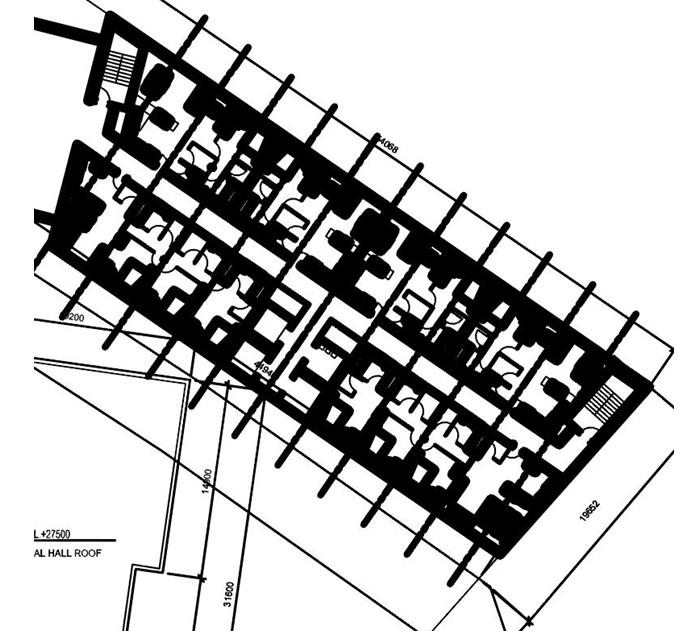
Black blobbed but beautiful?

From the beginning of the year, I’ve commented on just-about-everything in my daily BIM-blog.
Some posts were received better than others, with feedback both positive and negative.
It did get me a little bit by surprise to get by far the worst hammering on the ‘booby-trapping’ post.

Many people felt offended by me implying that consultants intentionally employ those practices. (paranoia was mentioned);
No one argued about my observations accuracy. Only that the practices described were done that way by design.

So, these dubious practices just happen by accident?
Or have they been designed NOT to booby trap – i.e. instead support speedy navigation and interpretation of documents?
Maybe there are clever navigation gadgets built in those documents that I am yet to discover? 
Really good reasons to do silly scales and number-only identification of CAD drawings;
Has Autodesk come up with a DWF barcode viewer that will show me what is within the drawing if a hover my mouse over the string of numbers?*
Do PDF’s no longer keep electronic bookmarks under their bookmark tabs but react on users thinking of them?

I’d love to see little explanations on tender documents outlining the authors’ intention on how those should be navigated through, so I do not second guess them and get into trouble;
Or better still, why don’t they try navigating them themselves before issue?


*  the Windows thumbnails do not count – at their size one can’t properly assess the content of the drawing;